
NEWS UPDATE 1:
Student Spotlight: Bailey-Rose’s Golfing Journey – From Surrey to Spain and Beyond
From the moment she picked up a golf club at just five years old, Bailey-Rose has shown that determination, discipline, and a love of sport can take you far.
This season, Bailey-Rose has competed in a range of tournaments, including the Robert Rock Tour, the Rookie Tour, and the US Kids Golf Tour. Completing a full calendar of competitions with remarkable results while still at school. Representing the Surrey County Team, she recently helped secure a win against eight boroughs, including Dorset and Kent.
In February, Bailey-Rose took her first step onto the international stage, competing in Spain – and winning! Her impressive season on the Robert Rock Tour earned her first place in the Order of Merit, qualifying her for the Junior World Championships in Ireland this July. There, she finished 13th out of 21 in what is known as the world’s biggest children’s golf competition, an unforgettable experience filled with new friendships and challenges.
“Lots of people think golf is just hitting a ball,” she says with a smile, “but every time I’ve ever got a friend to try, they usually miss on the first swing!”
Currently holding a handicap of 14.4, a number that’s been steadily dropping, Bailey-Rose continues to practise every week, even when winter weather keeps her off the course.
Her passion for the sport has also led her to feature in a golf documentary with Hashtag Agency, where she shared her journey and encouraged other young people to take up golf. Last summer, she also travelled to Scotland to watch the Women’s Golf Championships, gaining even more inspiration from professional players.
As Bailey-Rose continues her journey, one thing is clear: her dedication to golf is as strong as her drive off the tee.
NEWS UPDATE 2:
Faculty Spotlight: Mr Parr’s Dance Journey
We are delighted to spotlight our very own Teacher of Dance, Mr Parr. Since arriving at Marymount at the beginning of this year, Mr Parr has brought great enthusiasm, experience and energy, with which he has harnessed students’ innate talent and passion for dance.
From his first dance class at the age of six to graduating from the Rambert School of Ballet and Contemporary Dance, one of the UK’s leading dance schools, he has built an extensive professional career across stage, screen and opera.
He includes renowned organisations such as the English National Opera and Holstebro Dance Company among his previous collaborators, and his work on screen includes Netflix’s acclaimed TV series, Bridgerton.
Beyond this, he has also toured internationally with Years & Years and appeared in commercial projects for brands such as Burberry, Adidas, Craig Green, and Ministry of Sound.
Alongside all of his impressive achievements, Mr Parr has a talent for teaching dance, where his passion has translated to mentoring others. After beginning his teaching career at London Boys Ballet School, his expertise took him overseas, working with third-year students at the Escuela Profesional de Danza de Castilla y León in Spain, and leading dance workshops at Danstudio in Singapore. In London, he currently teaches Contemporary Dance at the Royal Ballet School, alongside Marymount London.
As well as dance education, he has a strong interest in choreography and movement direction, and has created works for Hampshire Youth Dance Company, London Fashion Week, and The Point Theatre’s GradLab.
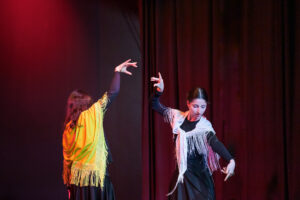
Today, we are celebrating teachers like Mr Parr who are bringing the art of dance to life through both performance and teaching. He has already made a significant impact on our students, choreographing our recent, highly successful Dance Showcase, and we are grateful to him for inspiring the next generation of dancers with his dedication and creative insight.
NEWS UPDATE 3:
Forward-thinking: Why I Fell in Love with the International Baccalaureate Programme
By Hyun Jung Owen, Middle Years Programme (MYP) Coordinator at Marymount International School London
I first joined an IB school about 20 years ago, after a few years of teaching in two different national curricula. What I initially loved about the programme was the teacher autonomy, which is not always guaranteed in other curricula. As I came into education with a mission to make learning relevant to my learners, I always felt that following a pre-determined, somewhat restricted curriculum was a hindrance to my teaching. What I wanted to teach was always what was happening right now, but often in national curricula, what we were meant to teach was often distant from what my students were thinking and experiencing at the time. The IB, however, gave teachers the freedom to shape what we teach within the framework. The more I learned about the framework, the more I felt that this is what I had been looking for all those years of teaching.
The IB framework encourages teachers to not only teach knowledge and skills but also to teach students how to think deeply, approach their learning, and apply their knowledge to new situations. The IB assessment criteria incorporate Bloom’s taxonomy so that teachers assess students’ ability to remember, understand, apply, analyse, evaluate, and create. We encourage our students to develop higher-order thinking skills, moving from basic knowledge recall to generating new, original ideas. This starts with teaching for deep understanding and transfer.
Now, teaching for deep understanding and transfer takes some time for a lot of teachers to master. But once we know how to teach through intentionally designed guiding questions (inquiry-based learning) that nudge student thinking from factual to conceptual understanding, the results are transformative. We see our students’ thinking and meaning making in the classroom in various learning experiences we design. This way of teaching is fundamentally based on our belief in constructivism – a learning theory stating that individuals actively construct their own knowledge and meaning from experiences. The beauty of this way of teaching is that my students surprise me every day. I feel fortunate to hear their original thinking, because they feel safe to make mistakes and come up with new ideas, and to collectively build a deeper understanding about complex global issues, because we are happy to share and build on each other’s ideas.
Contextual learning is also an important element of the IB framework. It allows us to link subject-specific learning to real-world situations. It becomes our job to come up with real-world scenarios where students can think like experts in the subject and to provide relevant case studies for our students to delve into, to deeply understand transferable ideas. Therefore, our students truly become the active members of the learning process, not passengers, but drivers. It is ultimately what we teachers want to do when we teach; we would like our students to go above and beyond our expectations.
In my conclusion, I would like to quote Professor Guy Claxton, author of The Future of Teaching and the Myths That Hold It Back, in his praise for the book ‘Learning as If Life Depended on It’ by Olli-Pekka Heinonen, Director General of the International Baccalaureate Organisation: ‘Civilisation is under threat. Large numbers of people who are thoughtful, ethical, and brave are required to protect it. Education ought to be the incubator of such people. Educationists who can see clearly what’s needed and show schools the way back to their fundamental purpose are in short supply – but Olli-Pekka Heinonen has emerged as the leader of this small but crucial pack.’ I am forever grateful and proud to be part of this pack of innovative and forward-thinking educators who consistently seek ways to educate young minds to be great human thinkers who will navigate complex problems and build a positive future for all.